
Make sustainability data useful for business with LCA Navigator
Why sustainability data does not create value today
Most industrial companies have already taken important steps in sustainability. Climate calculations are carried out, EPDs are developed, and access to data is increasing. But one key challenge remains:
Sustainability data is not used where it creates the most value.
Instead of driving decisions, it often gets stuck in reports and individual analyses, far from product development, purchasing, and business strategy. At the same time, pressure is increasing. CSRD, digital product passports, and customer requirements mean that companies not only need to report, but also act on their data. This creates a clear gap. LCA is often used too late, when the product is already finished. The result is a receipt — not a tool for making an impact.
But the real challenge is bigger than that: it is not only about producing data, but about making it usable. In many organizations, environmental data is:
- Spread across different systems and projects
- Difficult to reuse
- Inconsistent in quality and structure
The consequence is high costs, slow processes, and decisions made without the right basis. To succeed, a shift is needed — from isolated analyses to structured, accessible, and decision-driving life cycle data.
Just as quality once moved from being a side function to a business-critical core process, sustainability data is now facing the same transformation.
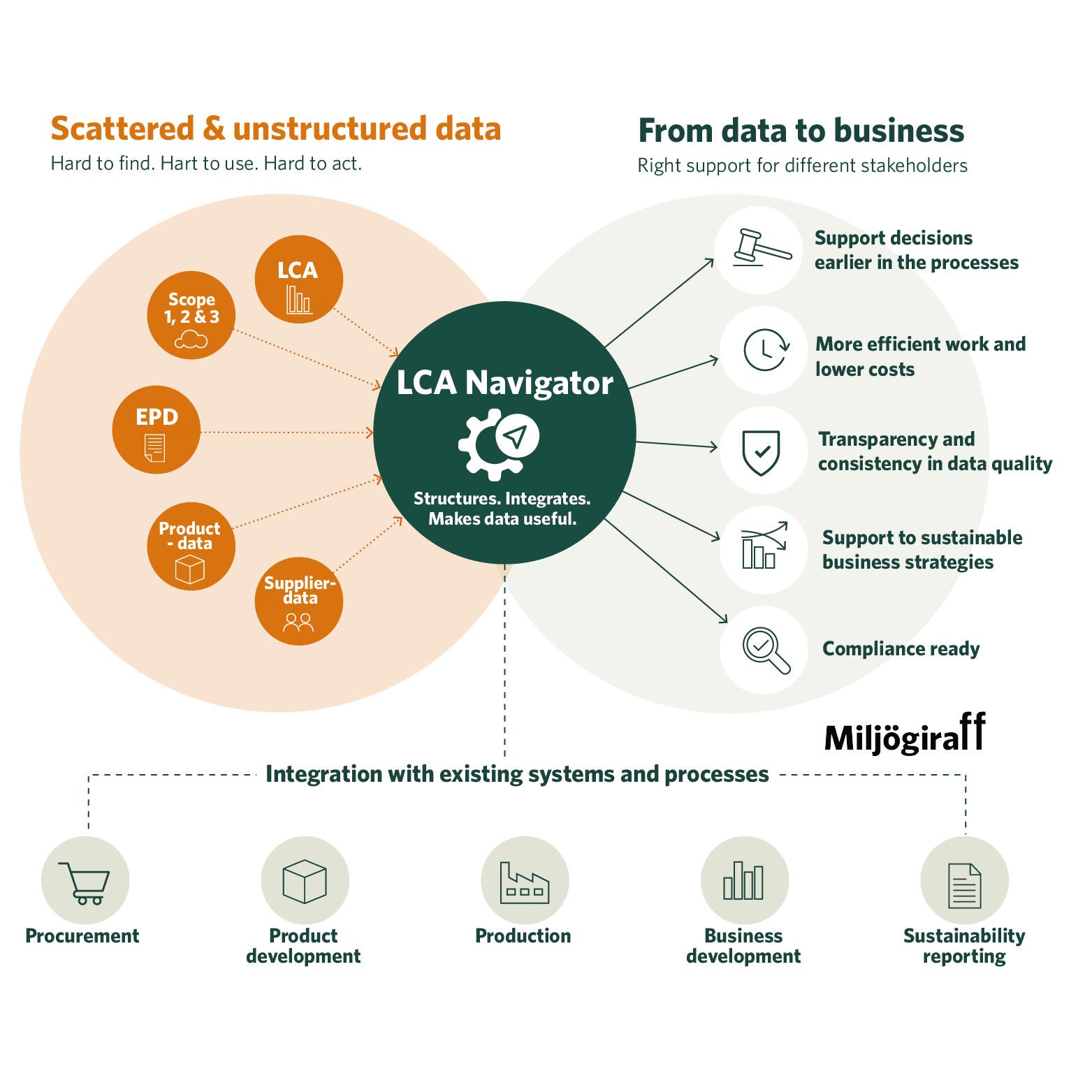
This is where LCA Navigator makes a difference.
With LCA Navigator, you can:
- Collect and structure your LCI data in your own library, integrated into existing systems
- Analyze multiple scenarios and make better decisions early
- Gain a full overview of your LCA work
- Make sustainability data an active tool in your organization
The purpose is to move from reporting to steering, from data to business value.
LCA Navigator — a method for integrating LCA data into the organization
LCA Navigator is an approach and method used by Miljögiraff to help organizations gradually integrate life cycle data into their operations.
The purpose is to make environmental data a natural and integrated part of how companies develop products, make decisions, and run their businesses. The overall ambition is to help organizations, in a structured and practical way, progressively steer their products and business toward solutions that fit within planetary boundaries.
How the work is designed in practice depends on the organization’s maturity level, internal capacity, and the regulatory landscape in which the business operates. LCA Navigator is therefore not a single tool, but a way of working in which different tools and structures can be used depending on the organization’s needs and level of development.
A central component of the way of working is to build a structured LCA database where quality-assured environmental data is collected and managed over time. Through such a structure, the organization can reuse previous analyses, simulate changes in products and processes, create aggregated climate calculations, and generate documentation for reporting or declarations.
The database makes it possible to use the same underlying data at both product level and organizational level, creating better traceability, higher reliability, and more efficient analyses. At the same time, long-term structural capital is built in the form of models, databases, templates, and ways of working. Miljögiraff is responsible for methodology, structure, and data quality, while the organization gradually builds its own capability to use and develop data in its processes.
Integrate LCA data into existing systems and processes
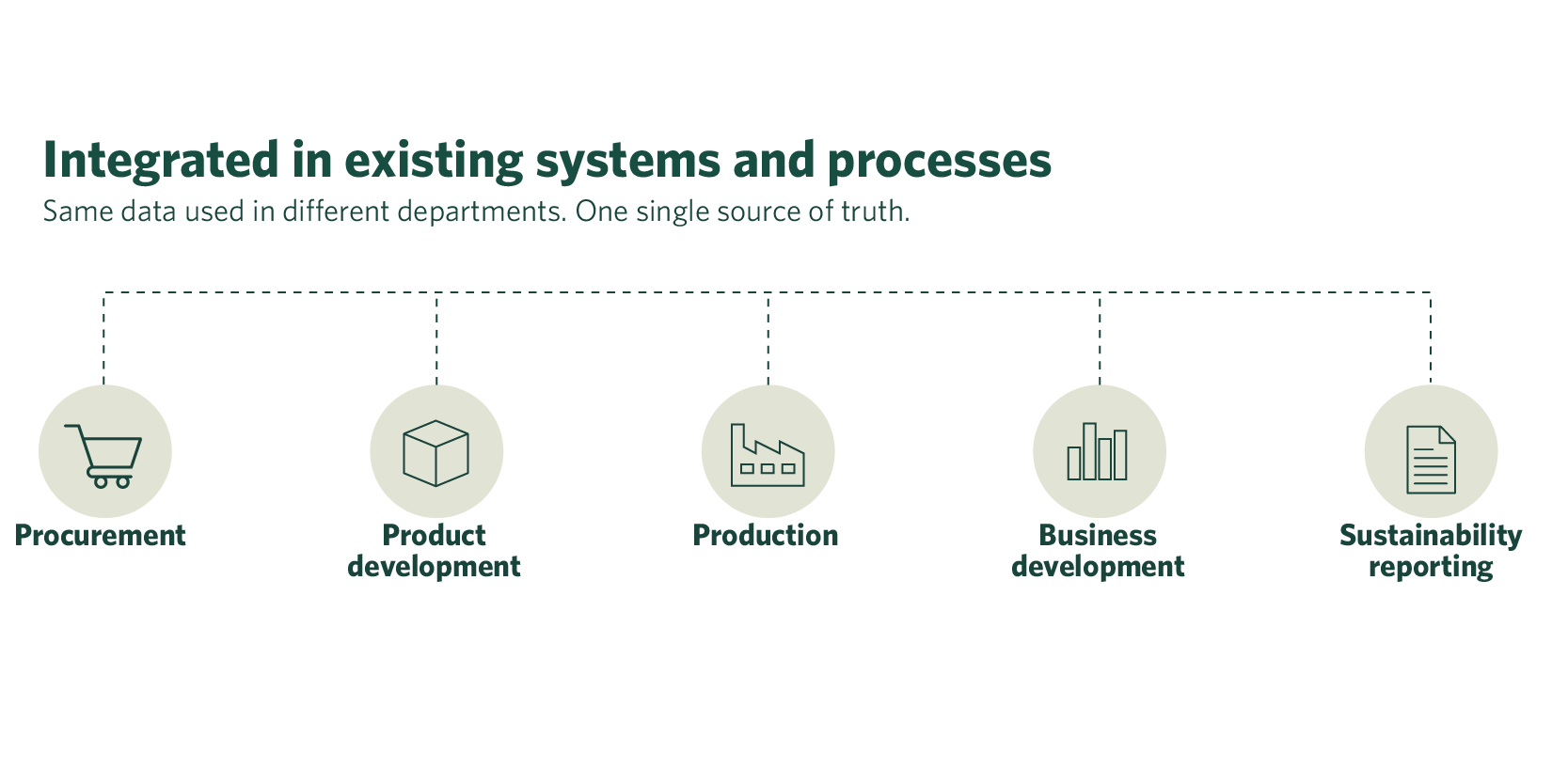
The overall ambition of LCA Navigator is for environmental impact data to become a natural and integrated part of the organization’s established processes. Instead of creating yet another separate system, the approach aims to integrate environmental data into the systems and workflows the organization already uses.
When the organization is ready, data from LCA Navigator can be integrated into systems such as ERP, PDM, or PLM through API solutions. Because the database is managed and updated according to established standards, environmental data can be kept up to date without creating a new administrative layer.
In this way, life cycle data becomes part of the organization’s existing information structure and can be used in product development, purchasing, production, business development, and sustainability reporting.
Tools for working structurally with sustainability data
Depending on the organization’s capacity, maturity level, and needs, different tools can be used within the framework of LCA Navigator. These tools are intended to integrate life cycle data into the organization’s existing processes and decision-making flows.
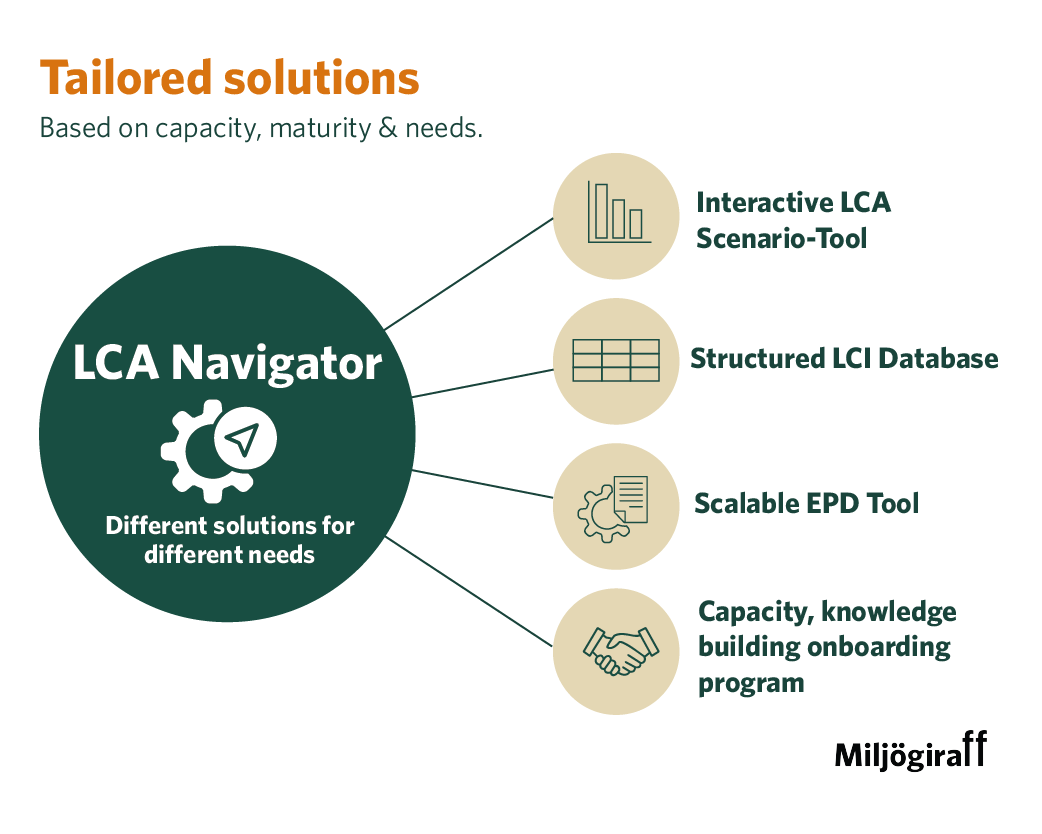
- LCA Navigator – Scenario Tool is used in the early stages of product configuration and development. It makes it possible to analyze and compare different materials, components, and design choices, enabling sales and development teams to simulate how different decisions affect climate and environmental performance before the product is fully developed.
- LCA Navigator Database is a structured database for collecting, quality-assuring, and managing data on environmental aspects. It makes it possible to use the same underlying data at both product level and organizational level. The database can be connected to business systems such as ERP, PDM, or PLM systems to communicate, for example, Product Carbon Footprint at assortment or portfolio level.
- LCA Navigator EPD Tool is a pre-verified tool for producing and preparing Environmental Product Declarations, EPDs, in a time- and cost-efficient way. The tool is based on structured data from the Navigator, making the process more cost-efficient and scalable.
- LCA Navigator Onboarding Program is a structured program for organizations that want to build their own capacity to work with LCA. The program includes methodological support, training, and the development of structural capital in the form of software, databases, models, templates, and ways of working. The purpose is to integrate life cycle data into the organization’s established processes and create long-term internal capability to work systematically with sustainability data.
Conclusion: From sustainability reporting to data-driven business value
Requirements for access to relevant and reliable sustainability data will continue to increase. The decisive question going forward is therefore not only how analyses are carried out, but how verified environmental data can be made useful in the organization’s daily work.
Through LCA Navigator, Miljögiraff helps organizations gradually build this capability. By combining methodology, structure, tools, and competence development, sustainability data can become a natural basis for decision-making in the organization’s work.
The goal is to create long-term structural capital where life cycle data is used continuously in the business, and where organizations gain better conditions for developing products and business models that fit within the planet’s ecological boundaries.
- Most companies have sustainability data — but do not use it in their most important decisions. Instead, it gets stuck in reports, while requirements from CSRD and customers increase.
- LCA Navigator makes data usable. By structuring and integrating life cycle data into the organization, companies can make better decisions — early.
- From isolated analyses to a scalable way of working.
- From reporting to business value.
How can we help you?
Fill in the contact form or email miljogiraff@miljogiraff.se and we will get back to you shortly.
Peace Love and giraffes!

Introduction to LCA — A course for those who want to learn how to use life cycle assessment in practice
Learn what the life cycle perspective means and how life cycle assessment (LCA) can be used in product development, purchasing, and reporting.
The course gives you a clear understanding of how results from life cycle assessments can be used to make sustainable material choices, prioritize measures, set requirements in the supply chain, and connect product data to the organization’s monitoring and reporting.
For those working in sustainability, product development, purchasing, or business development who need to be able to interpret and use environmental data in practice. Delivered live, digitally, or on site. We adapt it to your organization.