The Exponential Roadmap Initiative Provides Guidance in the 1.5°C Economy — LCA Makes It Measurable
When the world talks about “transitioning,” it is easy to get lost among climate pledges, strategies, and new frameworks. The Exponential Roadmap Initiative (ERI) stands out through its focus on pace, measurability, and real action through five clear pillars in an Exponential Business Playbook that shows the way.
At Miljögiraff, we use the five pillars in our work when supporting customers. Life cycle assessment (LCA) comes in as a clear method that translates the pillars into quantitative, comparable data that can be measured over time.
The Exponential Roadmap Initiative is based on a simple but demanding principle: to stay within 1.5°C, global emissions must be halved every decade. It is not a vision for 2050, but a concrete rhythm for change here and now. In this article, we provide an overview of the five pillars of the Exponential Business Playbook, Carbon Law, and how life cycle assessment fits into the picture.

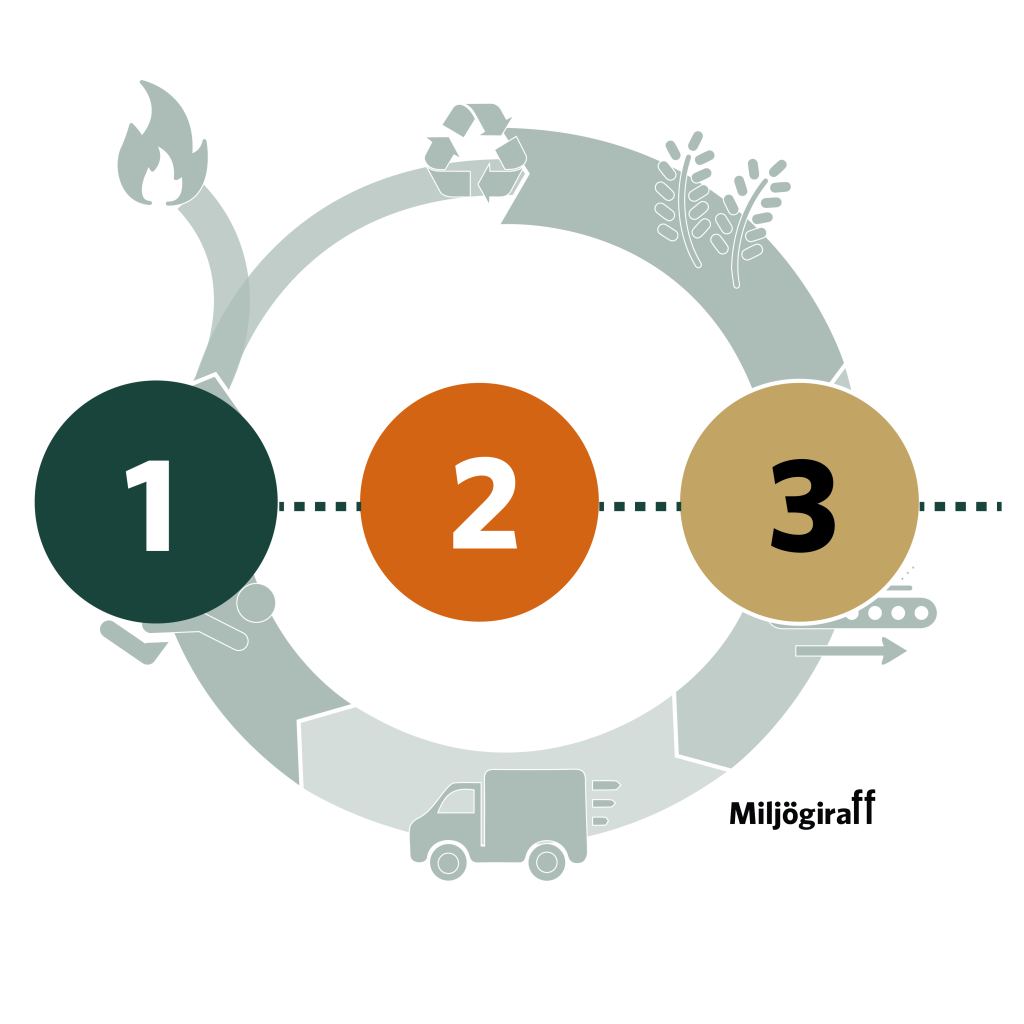
5 pillars that guide companies in acting in line with the 1.5°C target. Source: Exponential Business Playbook, 2025, Exponential Roadmap Initiative.
Carbon Law Is a Framework for Real Transformation
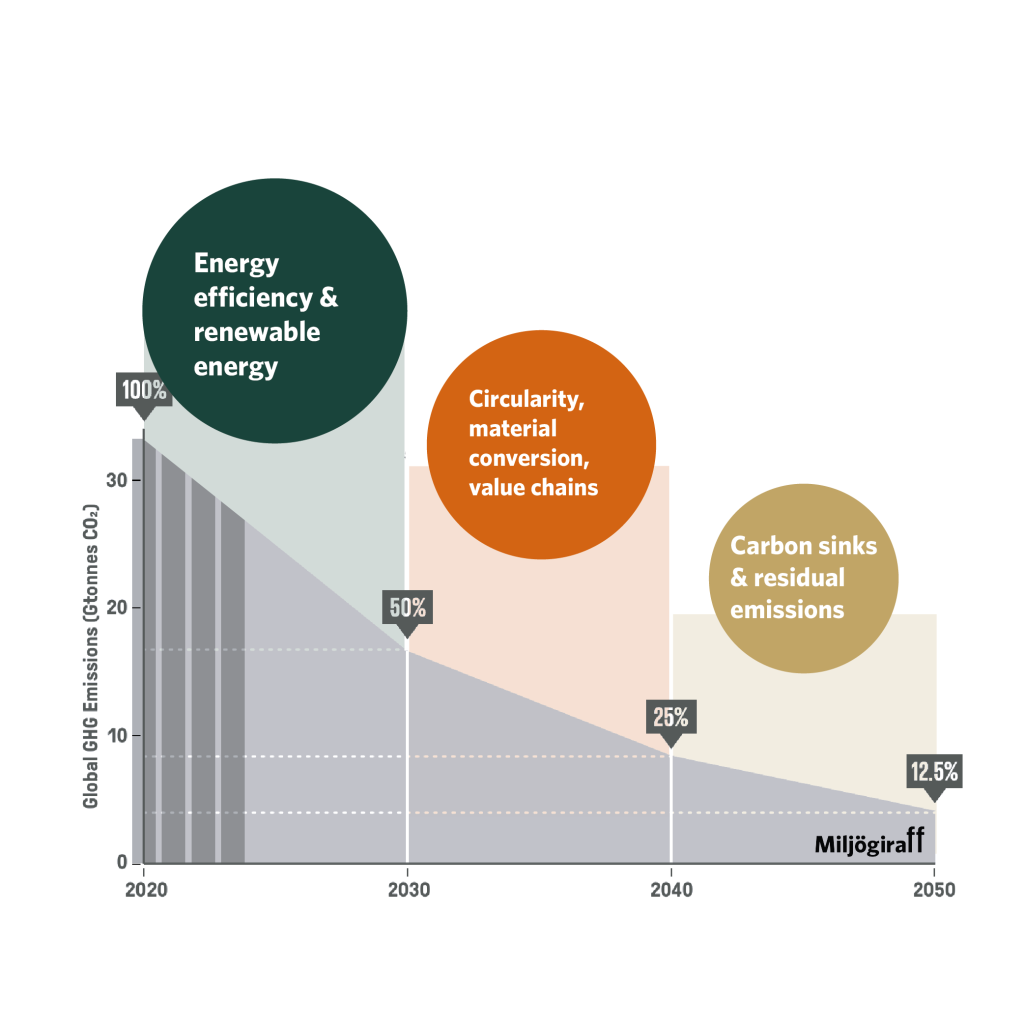
The Exponential Roadmap Initiative is based on Carbon Law — the idea that the world must halve emissions every ten years in order to stay within planetary boundaries.
It is a radical but clear target that requires companies to:
- scale solutions exponentially, not linearly
- prioritize actions that deliver impact in the near term
- follow up and adjust in line with actual emissions development

Carbon Law. Source: Exponential Business Playbook, 2025, Exponential Roadmap Initiative.
Carbon Law functions both as:
- a communicative narrative about pace and credibility
- a scientific direction
- a governance principle
With the Exponential Business Playbook, Companies Move from Ambition to Implementation
To help companies turn the 1.5°C ambition into practice, ERI has developed the Exponential Business Playbook.
The Playbook is built around five pillars that together describe what it means to be a 1.5°C company. It gives companies:
- KPIs and governance principles
- guidance for net-zero value chains
- deeper guidance on carbon sinks and removals: when, how, and under what conditions
The 5 Pillars
- Reduce your own emissions (Scope 1–2)
- Reduce value chain emissions (Scope 3)
- Scale climate solutions
- Invest in carbon sinks and removals with integrity
- Accelerate the transition in society
Together, they create a framework that connects climate targets, business strategy, innovation, and impact beyond the organization itself.

How Companies Can Use the Playbook in Practice
Working according to the Exponential Roadmap is not about inventing new methods, but about coordinating existing standards and tools within a clear structure.
A practical way to begin is:
- Baseline & targets
Create a robust current-state picture using LCA data and set targets in line with Carbon Law. - Scope 3 map
Identify the largest emission sources in the value chain. Use EPDs and PCFs where available. - Solution LCA
Evaluate how products and services actually contribute to emission reductions compared with relevant reference scenarios. - Transition plan & governance
Formulate actions, KPIs, and responsibilities. Ensure transparency through reporting according to ISSB/CSRD.
How Are the Playbook’s Pillars Connected to LCA?
One strength of the Exponential Roadmap is that it does not stop at target-setting. It helps companies understand how the value chain actually affects the climate — and how the transition can be quantified and followed up over time.
For us at Miljögiraff, this is exactly where life cycle assessment (LCA) comes in as a clear method that translates the pillars into quantitative, comparable data. With LCA, we can:
- identify emissions hotspots
- prioritize the right actions
- track actual emission reductions over time
At the same time, there are many analysis standards and data sources with different strengths and limitations. The key is to understand which analysis answers which question — and when more detail actually provides a better basis for decision-making.
Below, we summarize how the Playbook’s five pillars can be connected to LCA in practice, and which types of analyses and standards can be used to address each pillar.

Carbon Law as Governance, Narrative, and Tool
Using Carbon Law is about translating science into a pace for change. Companies can use the principle as a narrative, governance approach, and communication tool. Saying that you will reach net zero by 2050 can feel distant, but saying that you will halve emissions every ten years makes the target understandable and measurable.
It creates a rhythm in the transition:
2020–2030: first halving — energy efficiency and renewable energy
2030–2040: second halving — circularity, materials, and value chains
2040–2050: final halving — carbon sinks and remaining emissions
LCA as a Tool for Operationalizing Carbon Law
To know where the halvings can take place, we need to know what causes the emissions. Here, LCA is the practical tool that makes Carbon Law possible in everyday work.
- Carbon Law provides the direction
- Exponential Roadmap provides the structure
- LCA provides the numbers that guide decisions
It is at the intersection of science, data, and business that the transition actually happens.