
How Axjo built an LCA approach that creates value across the organization
Life cycle assessment (LCA) does not have to be a one-off analysis carried out to meet a specific requirement. Axjo’s journey shows how a long-term approach to LCA can build knowledge that supports multiple business needs, from product and business development and carbon footprint calculations to environmental product declarations (EPDs) and transparent environmental information throughout the value chain. Miljögiraff has been a partner throughout this journey, from training and capacity building to specialist support in LCA and EPD development.
Axjo started building knowledge before the requirements came into effect
When Axjo began expanding its work with life cycle assessment (LCA), customer requirements were not the main driving force. The company wanted to stay ahead and build knowledge before demand for product-related environmental information increased.
This also marked the beginning of the collaboration with Miljögiraff. One of the first steps was training in LCA and SimaPro, giving Axjo employees the opportunity to deepen their understanding of the life cycle perspective, methodology and tools used to conduct the assessments.

“When I started working with LCA at Axjo, it wasn’t something customers were asking for. The company wanted to be a frontrunner.”
Meliha Wikestad, Axjo
Since then, Axjo has continued to develop its LCA work, both independently and with support from external specialists. Miljögiraff has contributed expertise and support at different stages of this development. What started as an effort to build understanding has gradually become a foundation of knowledge that Axjo can build on as new questions and needs arise.
From analysis to multiple applications
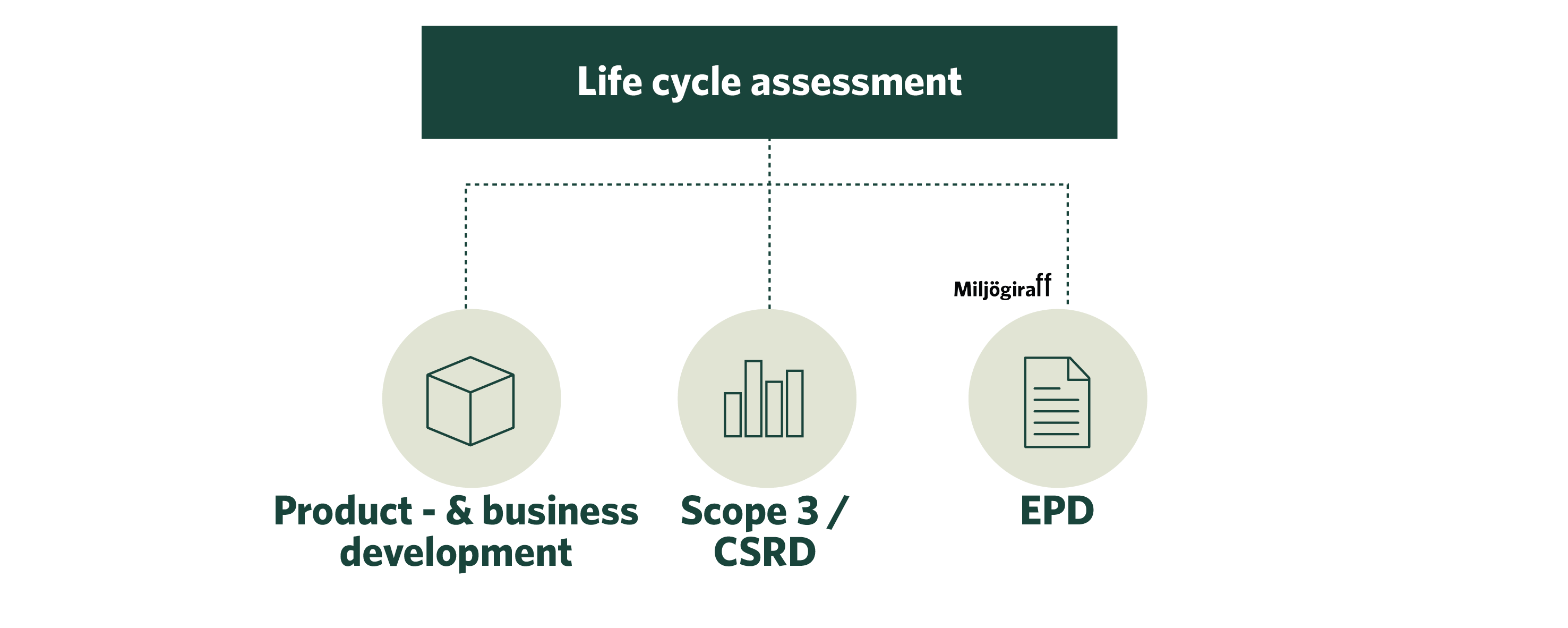
For Axjo, the value of LCA goes beyond calculating a single figure. It is about building knowledge that can be used across the business. The results can support decision-making and help set priorities, while also being integrated into product and business development.
Knowledge gained from the LCA work is also used to support Axjo’s carbon footprint calculations, including those related to Scope 3. More product-specific data can provide a more accurate basis for these calculations than relying solely on generic values.
In spring 2026, Axjo and Miljögiraff completed their latest project together. The work covered parts of Axjo’s product range, including cable drums and transport and storage crates. Axjo provided product and operational data, while Miljögiraff was responsible for modelling, calculations and analysis, among other tasks.
Demand for carbon footprint data and EPDs has grown since Axjo first started working with these issues. EPD information can, for example, be included in wholesalers’ product portals, making it accessible to their customers, including for use in procurement processes.
The same LCA work can therefore create value on multiple levels – by providing knowledge and supporting internal decision-making, contributing to carbon footprint calculations and making standardized environmental information available throughout the value chain.
“Vi använder kunskapen från vårt LCA-arbete i både produktutveckling och materialval. Ett konkret exempel är att resultaten tydligt har visat värdet av vårt retursystem, vilket har stärkt vårt beslut att fortsätta investera i och utveckla cirkulära lösningar med fokus på återanvändning. LCA-arbetet har därmed varit ett viktigt beslutsunderlag i vår strategiska inriktning.”
Meliha Wikestad, Axjo
Transparency is about showing the full picture
For Axjo, working with LCA and EPDs is also about being transparent about the environmental impact of its products. As a manufacturing company, Axjo uses both materials and energy. Just because a product contains recycled materials does not mean it has no environmental impact. By gaining a better understanding of its products’ life cycles, Axjo can present a more complete and nuanced picture rather than focusing only on individual product characteristics.
”Vi vill genuint öka transparensen och visa vad vi faktiskt håller på med.”
Victoria Balika, Axjo

When LCA becomes an ongoing way of working rather than a one-off project
Perhaps the most interesting aspect of Axjo’s journey is not any single LCA or EPD, but what happens when knowledge and experience are built up over time.
Axjo started by building expertise through training in LCA and SimaPro and has since continued to develop its LCA work, sometimes independently and sometimes with support from external specialists.
Miljögiraff has contributed at different stages of this journey: through training to build internal expertise, ongoing support and specialist knowledge, and LCA and EPD expertise when needed.
This means that LCA does not have to be a one-off deliverable. When expertise, data and experience are built up over time, the knowledge can be applied to a wider range of needs – from product and business development and internal priorities to carbon footprint calculations and environmental information throughout the value chain. The LCA approach becomes scalable and creates value across different parts of the organization.
Axjo’s journey also demonstrates the value of taking a long-term approach to LCA: not only to meet new requirements as they arise, but also to build knowledge that can support future decision-making.
Curious about how your company can take a long-term approach to LCA?
No matter where you are in your LCA journey, we can support you. Book a meeting with Fredrik at fredriktegstedt@miljogiraff.se or fill out the form below, and we’ll get in touch!