
Note: Same article can be found under “Case”
What Is the Climate Impact of Swedish Wool?
Wool has a very high climate footprint compared with other textile fibres when evaluated using LCA. The Swedish Wool Initiative contacted us at Miljögiraff to understand why this is the case. We conducted a study in which we looked more closely at how environmental impact, and specifically climate impact, from products made of Swedish wool can be calculated using life cycle assessment (LCA).
The aim of the study is to explain why results can differ so much between different analyses. One major reason for the variation is that environmental impact can be distributed between meat, wool, and other products from sheep farms according to different principles.
As a starting point, we examined two current Swedish value chains for wool and one future scenario in which the value chain is more integrated. Regardless of the value chain, sheep farming itself and the wool as a raw material always have the greatest negative impact on the final product. The study shows shortcomings in today’s background data and methods that need to be improved so that fair and transparent environmental product declarations, EPDs, can be developed for Swedish wool in the future.
The work has resulted in both new insights and important questions about how we calculate and value sustainability in relation to a living material.
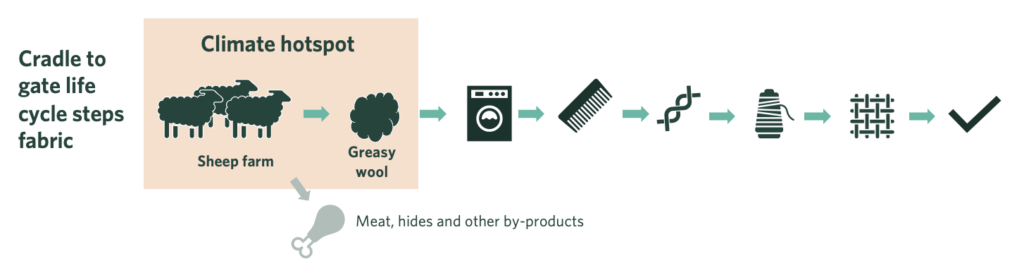
Climate Impact from Sheep to Finished Product
The analysis clearly shows that the largest share of wool’s climate impact occurs already on the sheep farm. This is mainly due to methane emissions from rumination, feed production, and manure management. But when calculating the climate impact of a wool product, a central question arises: how should emissions be distributed between the different products that sheep provide — meat, wool, hides, and sometimes other by-products?
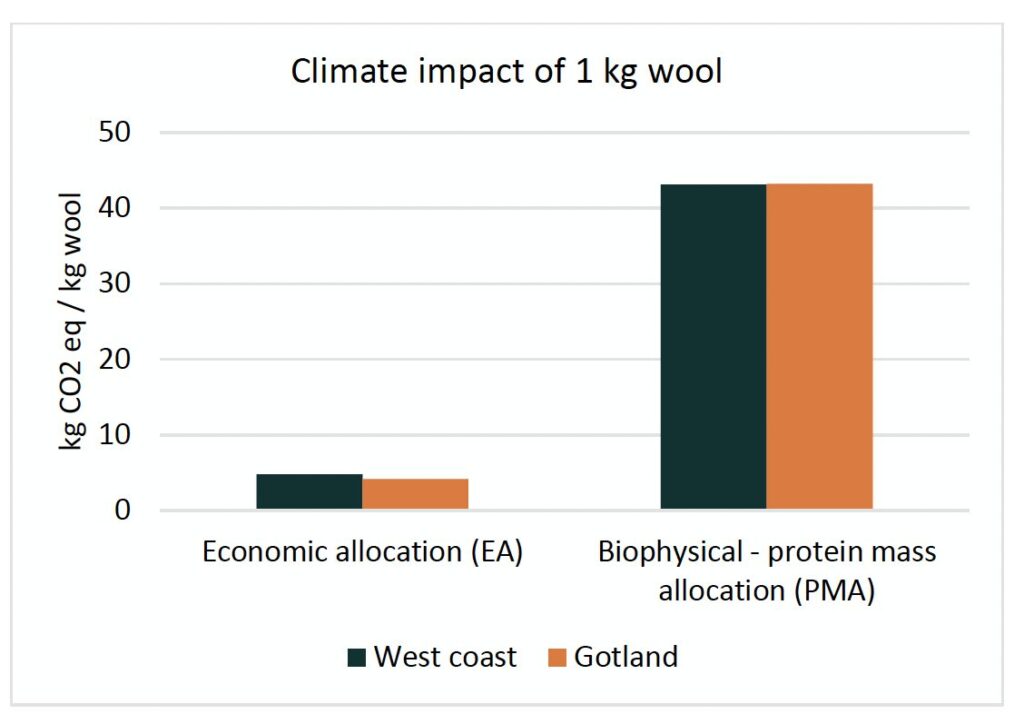
This is the core of the concept of allocation, a methodological question in LCA that can radically change the result. In Miljögiraff’s calculations, several ways of distributing the impact were tested.
- Economic allocation, where the distribution is determined by the market value of the products, results in a climate footprint of around 4–6 kg CO₂e per kilogram of wool.
- Physical allocation based on protein production instead gives up to 43 kg CO₂e per kilogram of wool.
The difference is substantial — and shows that the choice of method affects not only the figures, but also how we perceive wool’s climate impact and value. Today, both methods are used, which makes comparison difficult.
LCA as a Tool — Strengths and Limitations
LCA is currently the best available method for measuring environmental impact, but it is not without shortcomings. Measuring the environmental impact of living and renewable materials is a challenge for the method. The methodology is designed to analyse industrial systems, where processes and resource flows can be clearly quantified. When it is applied to agriculture and nature-based industries, such as Swedish sheep farming, the picture becomes more complex.
Current standards, such as ISO 14040–44, do not capture nature conservation, biodiversity, or cultural values.
But these aspects are central to Swedish wool production. Grazing sheep contribute to open landscapes, species-rich habitats, and a living cultural landscape — benefits that currently fall outside the scope of LCA. LCA can show where impacts occur, but it cannot determine on its own whether a material is sustainable.
The Swedish Context — From By-Product to Value Creator
In Sweden, meat is usually seen as the primary product from sheep farms, while wool is considered a by-product. This affects how emissions are distributed and, by extension, how wool is valued.
But Swedish sheep farming is more than meat production. It is also about nature conservation and ecosystem services. One possibility, as we at Miljögiraff see it, is to use economic allocation — where these values are also expressed in figures — to provide a fairer picture of the whole.
We Must Look Beyond Climate Impact — and Make Use of the Whole Sheep
Today, the focus is often on climate data and carbon emissions when we compare materials. Wool scores high there — there is no getting around it, because it has a high climate impact compared with other materials. But if we focus only on the figures, we risk missing the bigger picture.
We need to broaden the conversation and start talking about the real value of sheep — how they contribute to nature conservation, biodiversity, and living landscapes. When we measure climate impact, we should also ask ourselves what we actually value most: the product, the landscape, or the entire system around it?
To move forward, we need to create shared and realistic rules for how wool is assessed. The LCA method should not be a final answer, but a tool for understanding the impact and potential of materials.
We also need to make use of everything the sheep gives us — wool, meat, hides, and nature conservation — and stop letting anything go to waste. By creating incentives to keep sheep also for nature conservation purposes, we can preserve both ecosystems and cultural heritage.
Sweden may not become a major wool nation, but we can manage the resources we already have and maximise the value of our sheep.
Do You Have Questions About the Study or Are You Interested in Conducting an LCA?
Please do not hesitate to get in touch.