
GHG Scope 3: Start with Product-Specific Data from LCA/EPD — or with General Data?
When organizations begin calculating their GHG Scope 3 emissions, a common question arises: do you need to start directly with product-specific data from LCA or EPD, or is it acceptable to begin at a more general level using generic data?
The answer is that it depends on the requirements, drivers, and how mature the organization is in its sustainability work.
Different Paths into GHG Scope 3
GHG Scope 3 covers emissions across the entire value chain. Because of its broad scope, specific data on environmental impact from multiple suppliers is often not available. This gap needs to be filled when calculating Scope 3, either with specific data from suppliers or with generic data.
Some companies, such as Essem, have chosen to start with product-specific EPDs for their largest product groups. This provides good, specific results for the majority of their Scope 3 calculations. Other companies do not have access to product-specific LCA data at an early stage. In those cases, general data is often the most effective starting point.
General Data Provides Guidance
When specific data from completed LCAs is not available, the impact can be calculated using generic data based on standard assumptions for the production of the purchased product or material. This is a fully accepted and often necessary starting point for a GHG Scope 3 calculation.
The advantages of general data are that it:
- provides an overall picture of where emissions occur in the value chain
- makes it possible to prioritize where better data is needed based on where the environmental impact occurs
- creates an objective basis for a strategy regarding the next steps

Product-Specific Data for Better Decision-Making
Using more specific data in a GHG Scope 3 calculation makes it possible to get closer to reality, but it takes longer to produce. With data from product-specific LCAs or EPDs, companies can understand emissions at product or material level and, based on this, develop more targeted strategies and actions.
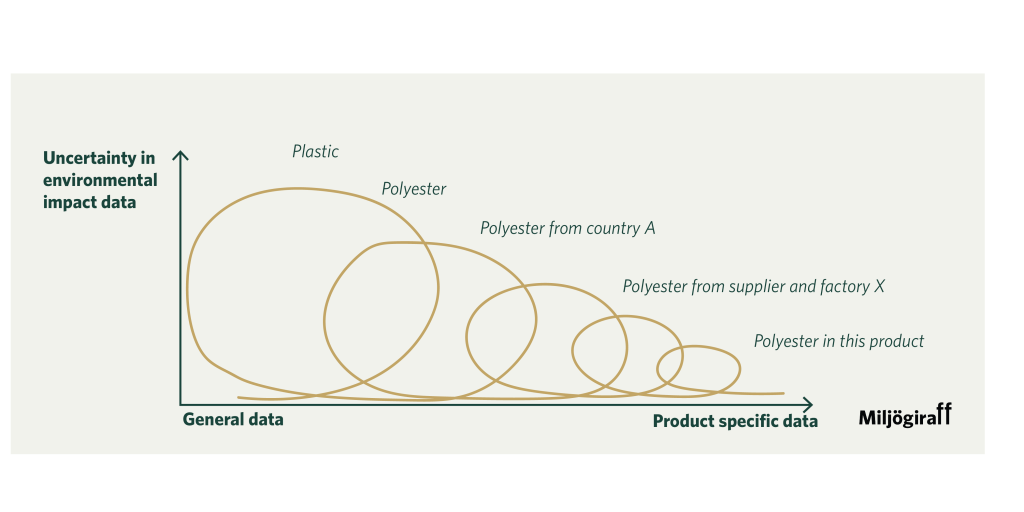
Our Advice: Work Iteratively with Data Quality
At Miljögiraff, we recommend an iterative approach to GHG Scope 3 data.
The most important thing is to get started, not that everything is perfect from the beginning.
An iterative process means that:
- you set a reasonable level of ambition based on resources and needs
- data quality is improved step by step where it makes the greatest difference, and the analysis is actively used to guide the next deepening
It is also common for requirements for detailed data to increase over time — from customers, legislation, and reporting frameworks such as CSRD.
Three Levels for GHG Scope 3 Calculations
One way to structure the work is to view it as three complementary levels:
Baseline for the entire Scope 3: Create a complete Scope 3 calculation using general data that provides an overview and helps prioritize where more specific data is required.
Better understanding of the largest emission items: Create more specific data, even if it does not need to be comprehensive. Focus, for example, on the 10 most important materials or purchases.
Full LCA for a key product: High data accuracy. Specific and complete data that supports EPDs, product development, communication of environmental impact, and strategic decisions.
What Does This Mean in Practice?
The choice between general and product-specific data is not either-or.
For most companies, the most effective path forward is to combine both over time.
GHG Scope 3 calculations should not become an obstacle to action. They should serve as decision support — developing in step with the organization’s knowledge, requirements, and ambition.