
Article by Matilda Lidfeldt, LCA Expert at Miljögiraff
The Climate Impact of Textiles from a Life Cycle Perspective
The environmental impact of the textile industry is a global challenge. Our consumption of clothing leads to water pollution, intensive use of water and land, large amounts of waste, and climate emissions. With a life cycle perspective, we can understand where in the value chain the impact occurs and where measures make the greatest difference.
One of the biggest drivers of emissions is that we produce and buy significantly more clothing than before. According to statistics from the Swedish Environmental Protection Agency, the average Swede consumes around 14 kilograms of textiles per year. Behind every garment is a long production chain in which environmental impact arises at several stages.
There is no single solution to these challenges. To reduce climate impact, measures are needed throughout the entire value chain — from production and design to use and end-of-life management. In this article, we go through where in a garment’s life cycle the climate impact is greatest, which measures can reduce it, and what the next steps may be.

Example: The Life Cycle of a T-Shirt, Step by Step
We use a typical garment, a cotton T-shirt, to illustrate the life cycle and climate impact of clothing. By analyzing the different stages of the garment, we can see where in the value chain emissions and resource use arise.
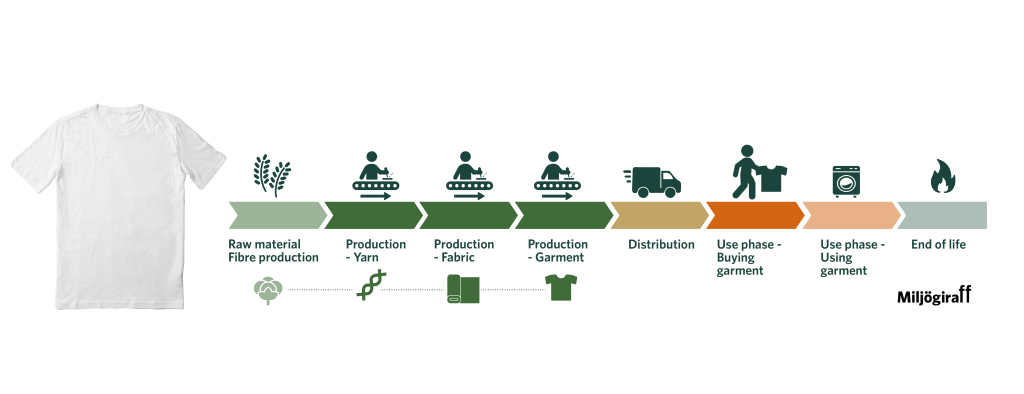
A T-shirt usually goes through several life cycle stages: fiber production, in this case cotton cultivation; yarn production and spinning; weaving or knitting; dyeing and finishing; sewing; transport from factory to store; the consumer’s transport to purchase; use; and end-of-life management.
These stages are illustrated in the image below. Climate impact can differ between different materials and garment types, but the life cycle often looks similar. The T-shirt is therefore used here as an example to show how the climate impact of clothing can be distributed across a garment’s life cycle. All sources used in the analysis are listed at the bottom of the article.
Where in the Life Cycle of Clothing Does the Greatest Climate Impact Occur?
The image clearly shows that the production of the T-shirt accounts for the largest climate impact in a garment’s life cycle. As much as 82% of a T-shirt’s climate impact occurs during the production phase. This means that most of the emissions have already occurred before the garment even reaches the store.
Of this 82%, around 10% comes from fiber production. The remaining impact occurs during the manufacturing of the T-shirt itself. This primarily involves energy-intensive processes such as yarn production, weaving, dyeing, and sewing, often in countries where energy systems still have a large share of fossil energy sources.

How Do Transports Affect Climate Impact?
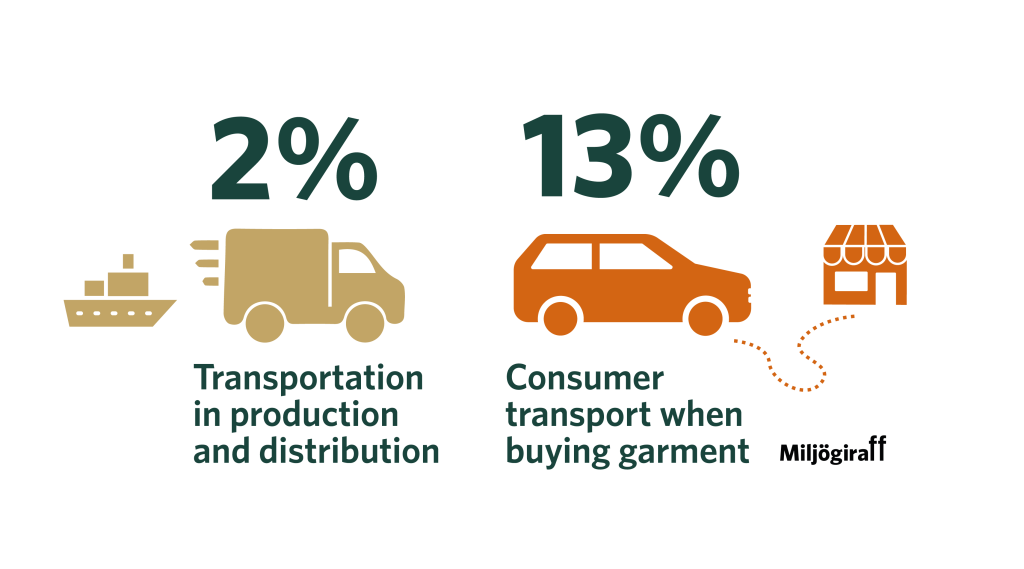
A common misconception about the climate impact of clothing is that a large share of emissions comes from transport. In fact, transport linked to production and distribution accounts for only around 2% of a garment’s total impact. This is because clothing is often transported by ship and truck, which are relatively efficient modes of transport per garment compared with the energy use in production.
However, there is one type of transport that has greater significance: the consumer’s own trip to buy a garment. If a garment is purchased during a separate car trip, that transport can account for approximately 13% of the climate impact, assuming the fuel is fossil-based.
How Do Use and Washing Affect the Climate Impact of Clothing?
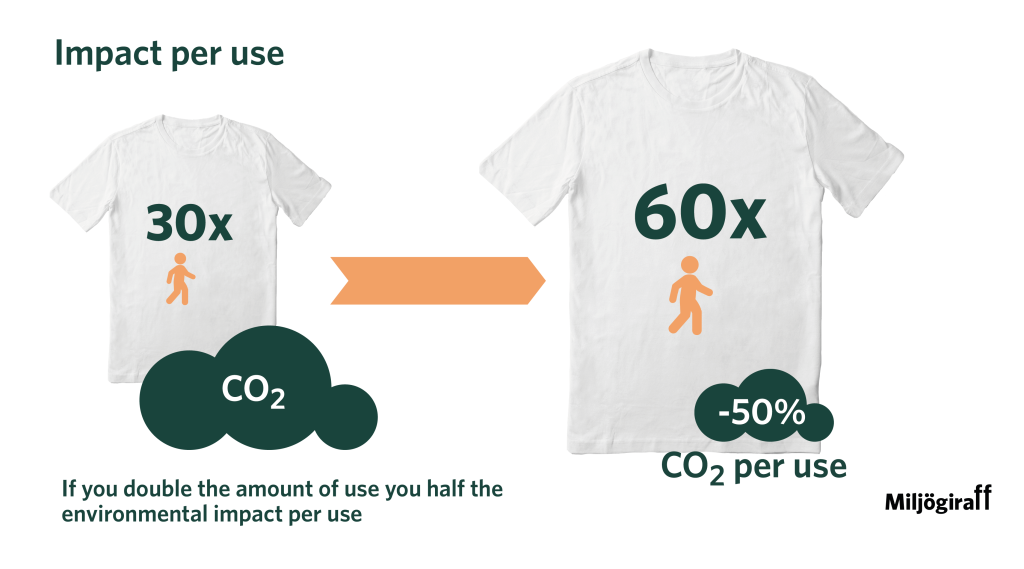
The use phase, meaning washing and wearing the T-shirt, accounts for about 3% of the total impact. This impact naturally depends on how long the T-shirt is used and where it is used. In this case, 30 uses are assumed, based on surveys conducted for Mistra Future Fashion. If the T-shirt had been used in a country with a higher share of fossil energy sources, the use phase would have had a significantly higher impact.
The pie chart earlier in the article shows the total climate impact of a T-shirt over its entire life cycle. But when we talk about the use phase, the climate impact per use is actually the most relevant measure. Since most emissions occur during production, the climate impact is “distributed” over more uses the longer the garment is used. The more times the T-shirt is worn, the lower the climate impact per wear. Extending the lifetime of clothing is therefore one of the most effective measures for reducing climate impact per use.
Waste management has a low climate-related impact. However, it is highly significant for resource use.
How Can Consumers Reduce the Climate Impact of Clothing?
Since the greatest climate impact from clothing occurs during production, the most effective thing consumers can do is reduce the need for new production. This means using the garments already in the wardrobe for as long as possible.
Extending the lifetime of a garment reduces the climate impact per use, because production emissions are then distributed over more occasions of use. Buying fewer garments, choosing quality that lasts, and supporting companies that offer repair or second-hand solutions can therefore make a big difference.
By using garments for longer and demanding more circular solutions, consumers also help drive development toward a more sustainable textile industry.
The greatest climate impact of a garment occurs before it even ends up in the wardrobe. That is also where the greatest potential for change lies: in how we produce, use, and extend the life of the garments that already exist. Through circular business models, longer lifetimes, and more thoughtful consumption, both companies and consumers can contribute to a textile industry with significantly lower climate impact.
Sources
- Naturvårdsverket. (2025). Textilkonsumtion, kilo per person i Sverige (Data och statistik). Naturvårdsverket. https://www.naturvardsverket.se/data-och-statistik/textil/textilkonsumtion/
- Sandin, G., Roos, S., Spak, B., Zamani, B., & Peters, G. (2019). Environmental assessment of Swedish clothing consumption – Six garments, sustainable futures. Mistra Future Fashion / RISE Research Institutes of Sweden. https://mistrafuturefashion.mistraprograms.org/publikationer/G.Sandin-Environmental-assessment-of-Swedish-clothing-consumption.MistraFutureFashionReport-2019.05.pdf
- Lidfeldt, M., Nellström, M., Sandin Albertsson, G., & Hallberg, E. (2022). Life cycle assessment of textile recycling products (SIPTex WP5 report). IVL Swedish Environmental Research Institute. https://ivl.diva-portal.org/smash/get/diva2:1718533/FULLTEXT01.pdf
- Nellström, M., & Lidfeldt, M. (2025). Busting the myths about sustainable fashion [TEDxGöteborg-talk]. YouTube. https://www.youtube.com/watch?v=1oBP7lCcdIw